What are the most used cooking conversions?
A US cup holds 8 fluid ounces, which is 16 tablespoons, 48 teaspoons or 236.6 mL. A tablespoon is half a fluid ounce, or 3 teaspoons. For weight, one ounce is 28.35 grams and 16 ounces make a pound. For ovens, 350 °F is 176.7 °C.
The liquid measures follow from three definitions in NIST Handbook 44: the measuring cup is 8 fluid ounces exactly, the measuring tablespoon is ½ fluid ounce exactly, and the teaspoon is ⅓ tablespoon exactly. Handbook 44 prints the fluid ounce as 29.573 mL. The exact value, 29.5735 mL, follows from 231 cubic inches per gallon and 128 fluid ounces per gallon, and that value turns every row below into milliliters.
| Measure | Tablespoons | Fluid ounces | Milliliters |
|---|---|---|---|
| 1 teaspoon | 0.33 | 0.17 | 4.9 |
| 1 tablespoon | 1 | 0.5 | 14.8 |
| ¼ cup | 4 | 2 | 59.1 |
| ⅓ cup | 5.33 | 2.67 | 78.9 |
| ½ cup | 8 | 4 | 118.3 |
| 1 cup | 16 | 8 | 236.6 |
| 1 pint (2 cups) | 32 | 16 | 473.2 |
| 1 quart (4 cups) | 64 | 32 | 946.4 |
| 1 gallon (16 cups) | 256 | 128 | 3,785.4 |
For a single unit in depth, open the matching guide: tablespoons in a cup, ounces in a cup, cups in a pint, quarts in a gallon and cups in a gallon. For any other amount, type the amount into the cups to ounces converter.
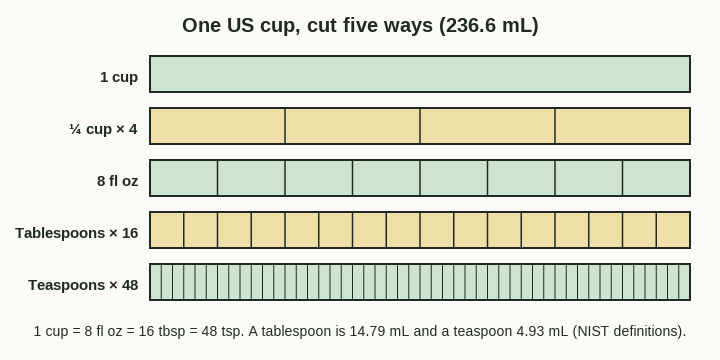
How many milliliters are in a cup, a tablespoon and a teaspoon?
The exact US kitchen cup is 236.59 mL, the tablespoon is 14.79 mL and the teaspoon is 4.93 mL. Nutrition labels and NIST's metric kitchen chart round them to 240, 15 and 5 mL. The label cup is 1.44% larger, which is under a teaspoon per cup.
The FDA rule for nutrition labeling, 21 CFR 101.9(b)(5)(viii), says a teaspoon means 5 mL, a tablespoon 15 mL, a cup 240 mL, 1 fl oz 30 mL and 1 oz in weight 28 g. The two sets differ, so check which one a recipe's milliliters follow when the page says.
| Measure | Exact (NIST definitions) | Handbook 44 table | Label rule and NIST chart |
|---|---|---|---|
| Teaspoon | 4.93 mL | 5 mL | 5 mL |
| Tablespoon | 14.79 mL | 15 mL | 15 mL |
| Fluid ounce | 29.57 mL | 29.573 mL | 30 mL |
| Cup | 236.59 mL | 237 mL | 240 mL |
The gap is 3.4 mL for one cup and 13.6 mL for four, a little less than one tablespoon. That is small for a soup and worth knowing for a tight baking recipe. The tablespoons in a cup guide shows why the count of 16 holds in either system.
NIST introduces its own metric kitchen chart as approximate equivalents. Set against the exact conversion, its entries run higher by 1.4% or less.
| US measure | Chart value | Exact value | Chart is higher by |
|---|---|---|---|
| ¼ cup | 60 mL | 59.1 mL | 1.4% |
| ⅓ cup | 80 mL | 78.9 mL | 1.4% |
| ½ cup | 120 mL | 118.3 mL | 1.4% |
| 1 cup | 240 mL | 236.6 mL | 1.4% |
| 1 pint | 480 mL | 473.2 mL | 1.4% |
| 1 quart | 950 mL | 946.4 mL | 0.4% |
| 1 gallon | 3,840 mL (3.84 L) | 3,785.4 mL | 1.4% |
The chart prints a quart as 950 mL, not 960 mL. Four label cups would give 960 mL, which is 1.4% above the exact quart, so the chart does not multiply cleanly. Use the exact value when you convert a full recipe, and the rounded one only for a glance.
How many grams are in an ounce and in a pound?
One ounce of weight is 28.35 grams (28.349523125 exactly), and a pound is 16 ounces or 453.6 grams. A fluid ounce measures volume, 29.57 mL, so a fluid ounce is not an ounce on a scale. Nutrition labels round the ounce to 28 g.
NIST Handbook 44 gives the avoirdupois ounce as 28.350 g and the pound as exactly 453.592 37 g. The NIST metric kitchen chart prints 28 g per ounce and 454 g per pound.
| Ounces | Pounds | Grams (exact) | Grams at 28 per ounce |
|---|---|---|---|
| 1 oz | 0.0625 | 28.3 | 28 |
| 2 oz | 0.125 | 56.7 | 56 |
| 4 oz | 0.25 | 113.4 | 112 |
| 8 oz | 0.5 | 226.8 | 224 |
| 12 oz | 0.75 | 340.2 | 336 |
| 16 oz | 1 | 453.6 | 448 |
| 32 oz | 2 | 907.2 | 896 |
The last column shows what rounding costs. Two pounds is 907.2 g exactly and 896 g at 28 g per ounce, a shortfall of 11.2 g.
More detail is in the guides on grams in an ounce, ounces in a pound and grams in a pound. For kilograms and pounds, use the kg to lbs converter.
How many grams are in a cup of flour, sugar or butter?
The weight depends on the ingredient, because a cup measures volume. On the King Arthur Baking chart, a cup of all-purpose flour is 120 g, granulated sugar 198 g, packed brown sugar 213 g and butter 226 g. Weigh when a recipe gives grams.
NIST's Metric Kitchen tips recommend weighing ingredients on a kitchen scale to improve accuracy, and King Arthur recommends a digital scale too. The chart below turns each of its printed rows into a figure per cup, so rows given for half a cup or a tablespoon line up.
| Ingredient | Chart row | Grams per cup | Ounces per cup |
|---|---|---|---|
| All-purpose flour | 1 cup = 120 g | 120 | 4.23 |
| Confectioners' sugar (unsifted) | 1 cup = 113 g | 113 | 3.99 |
| Granulated sugar | 1 cup = 198 g | 198 | 6.98 |
| Brown sugar, packed | 1 cup = 213 g | 213 | 7.51 |
| Cocoa powder (unsweetened) | 1/2 cup = 42 g | 84 | 2.96 |
| Butter | 8 tablespoons (1/2 cup) = 113 g | 226 | 7.97 |
| Vegetable oil | 1 cup = 198 g | 198 | 6.98 |
| Milk | 1 cup = 227 g | 227 | 8.01 |
| Honey | 1 tablespoon = 21 g | 336 | 11.85 |
| Table salt | 1 tablespoon = 18 g | 288 | 10.16 |
A cup of table salt is more than twice as heavy as a cup of flour. King Arthur notes that small differences come from rounding, and advises going by the weight in the recipe.
Convert any weight or volume with the grams to cups converter, or read the guides on cups in a pound of flour and cups in a pound of sugar.
What is 350 °F in Celsius, and what is gas mark 4?
350 °F is 176.7 °C, from °C = (°F − 32) ÷ 1.8. NIST's culinary temperature page lists cakes, cookies and brownies at 180 °C. Gas marks are not exact: Beko lists mark 4 as 177 °C and Smeg as 180 °C, so read your own oven's manual.
°C = (°F − 32) ÷ 1.8
°F = °C × 1.8 + 32
Recipes round the result, so the table shows the exact value and a value rounded to the nearest 5 °C, then converts the rounded value back to °F to show how far the value moved.
| Oven setting | °C, exact | °C, nearest 5 | The rounded °C back in °F |
|---|---|---|---|
| 250 °F | 121.1 | 120 | 248 °F |
| 300 °F | 148.9 | 150 | 302 °F |
| 325 °F | 162.8 | 165 | 329 °F |
| 350 °F | 176.7 | 175 | 347 °F |
| 375 °F | 190.6 | 190 | 374 °F |
| 400 °F | 204.4 | 205 | 401 °F |
| 425 °F | 218.3 | 220 | 428 °F |
| 450 °F | 232.2 | 230 | 446 °F |
| 500 °F | 260 | 260 | 500 °F |
NIST's culinary temperature page lists these oven ranges: slow is 150 to 160 °C (300 to 325 °F), moderate 180 to 190 °C (350 to 375 °F), hot 200 to 230 °C (400 to 450 °F) and very hot 230 to 260 °C (450 to 500 °F).
Gas marks come from oven makers, not from a standard, and the two charts below differ. Smeg also lists a fan oven setting 20 °C lower on every row.
| Gas mark | Beko, °C | Smeg, °C | Smeg, fan °C |
|---|---|---|---|
| Mark 3 | 165 | 160 | 140 |
| Mark 4 | 177 | 180 | 160 |
| Mark 5 | 190 | 190 | 170 |
| Mark 6 | 200 | 200 | 180 |
| Mark 7 | 220 | 220 | 200 |
| Mark 8 | 230 | 230 | 210 |
| Mark 9 | 245 | 240 | 220 |
Marks 3, 4 and 9 differ between the two makers. Beko adds that some of its products have different gas mark ratings and points to the user manual. For the exact value of any other temperature, use the Celsius to Fahrenheit converter. For safe meat temperatures, see the meat temperature chart.
How much is a stick of butter in cups, tablespoons and grams?
One US stick of butter is 8 tablespoons, ½ cup or 4 ounces, which the King Arthur Baking chart lists as 113 g. Two sticks make a cup (226 g) and four sticks make a pound. One tablespoon is ⅛ stick, about 14 g.
The table scales that chart row. Because the chart rounds a stick to 113 g, four sticks add up to 452 g, 1.6 g short of the exact 453.6 g in a pound. Use the grams on your butter's wrapper when the weight differs.
| Amount | Sticks | Ounces | Grams |
|---|---|---|---|
| 1 tablespoon | ⅛ | 0.5 | 14.1 |
| 2 tablespoons | ¼ | 1 | 28.3 |
| ¼ cup (4 tablespoons) | ½ | 2 | 56.5 |
| ⅓ cup (5⅓ tablespoons) | 0.67 | 2.67 | 75.3 |
| ½ cup (8 tablespoons) | 1 | 4 | 113 |
| ¾ cup (12 tablespoons) | 1½ | 6 | 169.5 |
| 1 cup (16 tablespoons) | 2 | 8 | 226 |
| 2 cups (32 tablespoons) | 4 | 16 | 452 |
The tablespoons in a stick of butter guide covers wrapper marks and teaspoon counts.
Worked example: how do I convert one recipe to metric?
Take a muffin recipe that calls for 1½ cups all-purpose flour, ¾ cup milk, 4 tablespoons butter and a 350 °F oven. Convert each line with the factors above, then round once at the end. Flour and butter go to grams, and the milk can stay in milliliters.
- Flour: 1.5 × 120 g = 180 g on the King Arthur chart.
- Milk by volume: ¾ cup = 177.4 mL, the same figure the cups to ounces converter returns.
- Milk by weight: 0.75 × 227 g = 170.3 g on the same chart. Milliliters and grams are separate measures, so use the unit your recipe states.
- Butter: 4 tablespoons is half a stick, 2 ounces, 56.5 g.
- Oven: 350 °F = 176.7 °C, rounded to 175 °C or 180 °C as your recipe prefers.
To make a different number of muffins, scale first with the recipe scaling calculator and convert after. The milliliter step opens ready-filled in the converter with the button below.
Which conversion mistakes change a recipe the most?
The biggest errors mix systems: a fluid ounce read as a weight ounce, a label cup mixed with a kitchen cup, or a tablespoon swapped with a teaspoon. Each one changes an amount by a few percent or by a factor of three.
- Fluid ounce and ounce. NIST lists the fluid ounce and the avoirdupois ounce as two different units. A cup of flour is 8 fluid ounces of space and 4.23 ounces of weight.
- Dry and liquid cups. NIST calls using a dry measuring cup in place of a fluid one a common way to introduce measurement errors. Use a dry cup for flour and a marked liquid cup for milk.
- Rounding every line. Round the finished amount, not each step. Rounding 236.6 mL up to 240 mL on four cups adds about 14 mL.
- Counting the teaspoon wrong. A tablespoon is 3 teaspoons. In salt or baking powder, a swap is a threefold error.
- Trusting one gas mark chart. Two makers disagree by up to 5 °C on the same mark.
When a recipe lists both cups and grams, follow the grams. Open the cups to ounces converter for volume and the grams to cups converter for weight.
Frequently asked questions
Why do gas mark charts show different temperatures?
Gas marks are set by oven makers, not by a standard. Beko lists mark 4 as 177 °C and Smeg lists it as 180 °C. Beko says some products have different ratings, so read your own manual.
Why does the NIST kitchen chart list a quart as 950 mL?
NIST presents the chart as approximate equivalents. It rounds the quart to 950 mL, although four 240 mL cups would be 960 mL. The exact US quart is 946.35 mL.
Should I measure ingredients by weight instead of by cup?
NIST and King Arthur Baking both recommend weighing on a kitchen scale. A cup measures volume, and the weight of a cup changes with the ingredient: 120 g for all-purpose flour and 198 g for granulated sugar.
What is 425 °F in Celsius?
425 °F is 218.3 °C. Both Beko and Smeg list 220 °C for gas mark 7.
Sources
- NIST: Metric Kitchen, Cooking Measurement Equivalenciesnist.gov
- NIST: Metric Kitchen, Culinary Temperaturenist.gov
- NIST: Metric Kitchen, Culinary Measurement Tipsnist.gov
- NIST: Handbook 44 (2026), Appendix C, General Tables of Units of Measurementnist.gov
- FDA: 21 CFR 101.9, Nutrition labeling of food (CFR, April 1, 2025 edition)govinfo.gov
- King Arthur Baking: Ingredient Weight Chartkingarthurbaking.com
- Beko UK: Oven Temperature Conversionsbeko.co.uk
- Smeg UK: Oven Temperature Conversionssmeguk.com