What should I measure and buy each month?
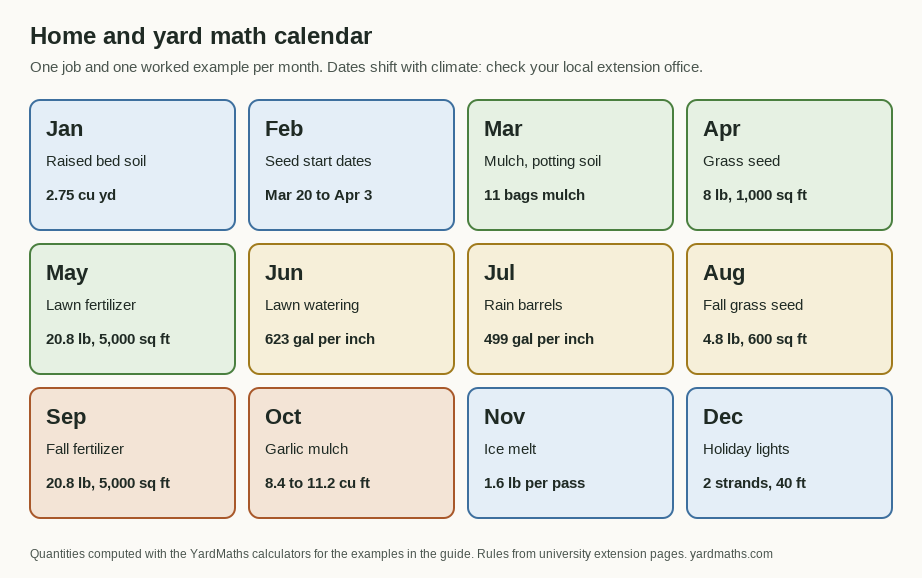
Each month has one or two jobs where a measurement turns into a purchase: soil by the cubic yard, seed and fertilizer by the pound, ice melt by the bag. The table shows one worked example for every month. The examples are ours, computed with the linked calculators, and your numbers will differ.
| Month | Job | Example result | Calculator |
|---|---|---|---|
| January | Raised bed soil | 2.75 cu yd for two 8 × 4 ft beds, 12 in deep | Raised bed soil |
| February | Seed starting dates | March 20 to April 3 for a May 15 planting | Date calculator |
| March | Mulch and potting soil | 11 bags of 2 cu ft; 6 bags of 8 qt | Mulch and potting soil |
| April | Grass seed, spring | 8 lb for 1,000 sq ft | Grass seed |
| May | Lawn fertilizer | 20.8 lb for 5,000 sq ft | Fertilizer |
| June | Lawn watering | 623 gal per inch on 1,000 sq ft; 62 min at 10 gpm | GPM |
| July | Rain barrels | 499 gal per inch from 1,000 sq ft; 10 barrels | Rainwater harvesting |
| August | Grass seed, fall | 4.8 lb for 600 sq ft | Grass seed |
| September | Lawn fertilizer | 20.8 lb for 5,000 sq ft | Fertilizer |
| October | Garlic bed mulch | 8.4 to 11.2 cu ft for 32 sq ft | Mulch |
| November | Ice melt | 1.6 lb a pass on 400 sq ft | Ice melt |
| December | Roofline lights | 2 strands; 7.2 kWh for the month | Christmas lights and electricity cost |
The next four sections explain each month, say which source sets the rule and show the math. Where a rule comes from an extension service in one state, the text says so.
What do I measure and buy from January to March?
Winter is for planning beds, working out seed dates and buying mulch before spring work starts. Each job below starts from a measurement you can take indoors from a sketch: the size of a bed, the planting date you want, or the pots you plan to fill.
January: raised bed soil
Utah State University Extension says a raised bed box should be at least 6 to 12 inches high, and a bed 3 to 4 feet wide is easy to reach from both sides. For example, two beds of 8 by 4 feet and 12 inches high hold 64 cubic feet. With 10% extra the order is 70.4 cubic feet, or 2.61 cubic yards, which the calculator rounds up to 2.75. Use the raised bed soil calculator.
February: seed starting dates
The University of Massachusetts says to count back from the outdoor planting date, 6 to 8 weeks for onions, tomatoes and peppers, and that the last frost date varies by area. For example, planting out on May 15 gives March 20 for 8 weeks and April 3 for 6 weeks. Subtract weeks with the date calculator.
March: mulch and potting soil
The University of Illinois Extension recommends a mulch depth of 2 to 4 inches, kept at least 4 inches from a trunk. An example bed 20 feet by 4 feet takes 14 cubic feet at 2 inches, 21 at 3 and 28 at 4, with 5% extra. At 3 inches that is 11 bags of 2 cubic feet. See the mulch calculator.
For containers, three example tapered pots, 12 inches across the top, 9 at the bottom and 11 deep, hold 1.66 cubic feet, or 42.8 quarts. That is 6 bags of 8 quarts. Try the potting soil calculator.
What do I measure and buy from April to June?
Spring jobs turn lawn area into pounds of seed and fertilizer, then into minutes of watering. Measure the lawn once, as length times width, and reuse that area for every lawn job below, so seed, fertilizer and water all come from one set of measurements and stay consistent.
April: grass seed
Iowa State University Extension says the time to establish a cool-season lawn from seed is mid-August to mid-September, and spring seeding from early April to mid-May is possible when irrigation is available. An example 40 by 25 foot patch is 1,000 square feet. At the calculator's tall fescue rate for new seeding, 8 pounds per 1,000 square feet, that is 8 pounds. See the grass seed calculator.
May: lawn fertilizer
Iowa State says that in Iowa, cool-season lawns can be fertilized in spring (April or May), mid-September, and late October or early November. It also says cool-season grasses should not be fertilized in June, July or August. Take an example 100 by 50 foot lawn, a 24-0-6 bag and an example rate of 1 pound of nitrogen per 1,000 square feet (use the rate on your own bag): 4.17 pounds of product per 1,000 square feet, 20.8 pounds in all, and 2 bags of 15 pounds. The label rate wins; use the fertilizer calculator.
June: lawn watering
Iowa State says garden spaces, lawns included, perform best with an inch of water each week, and says 1 inch on 1 square foot takes 0.623 gallons. For an example 1,000 square feet that is 623 gallons. An example sprinkler delivering 10 gallons per minute needs 62.3 minutes. Use the GPM calculator, or time the sprinkler with cans as the source describes.
What do I measure and buy from July to September?
Summer is the time for rain barrels and for ordering fall seed. The fall window for cool-season lawns opens in mid-August in Iowa, so measure bare spots in July, then buy seed and fertilizer before that window opens. Warm-season lawns and other regions follow different dates.
July: rain barrels
Using the same 0.623 gallons per square foot per inch from Iowa State, an example 40 by 25 foot roof section is 1,000 square feet and gives 623 gallons per inch at full capture. No system catches it all. At an assumed 80% capture it is 498.7 gallons, or 10 barrels of 55 gallons. See the rainwater harvesting calculator.
August: fall grass seed
Iowa State gives mid-August to mid-September for seeding a cool-season lawn from seed. An example 30 by 20 foot area is 600 square feet and needs 4.8 pounds at 8 pounds per 1,000 square feet. Round up to the bag size. The grass seed calculator gives the bags.
September: fall fertilizer
Mid-September is one of the three fertilizer windows Iowa State lists for cool-season lawns in Iowa. The math repeats May: 20.8 pounds for the same 5,000 square feet. Check the bag rate again, because it can differ by product.
What do I measure and buy from October to December?
Late fall jobs protect what you planted and prepare for ice and the holidays. Each one comes down to a small area: a garlic bed, a driveway, a roofline. Measure each once, then buy only the quantity the calculator shows.
October: garlic bed mulch
The University of Minnesota Extension says to plant garlic in the fall, usually one or two weeks after the first killing frost, with the clove base 2 to 3 inches below the surface, and to cover the bed with 3 to 4 inches of leaf or straw mulch. An example bed 8 by 4 feet needs 8.4 to 11.2 cubic feet with 5% extra. For spacing, read how far apart to plant garlic.
November: ice melt
The University of Minnesota's SmartWinterSalt guide says to apply about 1 pound of salt per 250 square feet for larger areas, and no more than 4 pounds per 1,000 square feet. An example 20 by 20 foot driveway is 400 square feet, so one pass takes 1.6 pounds and four passes 6.4 pounds, which fits one 40 pound bag. Use the ice melt calculator. For pipes, see how to keep pipes from freezing.
December: holiday lights
For an example 40 ft roofline, with strands that light 25 ft and hold 100 bulbs, divide the length by the lit length of one strand and round up: 40 ÷ 25 = 1.6, so 2 strands and 200 bulbs. If the label says 20 watts a strand, the load is 40 watts. At an example six hours a night for 30 nights, the load uses 7.2 kWh and costs $1.31 at the calculator's default rate, which you should replace with your own. See the Christmas lights calculator and the electricity cost calculator.
How do I adjust the calendar for my climate?
Start from your own last and first frost dates and your own grass type, then shift each month earlier or later. The extension pages above describe their own regions, so the months here are starting points. Your county extension office is the local authority on dates.
- Seed starting: the University of Massachusetts says to count back from your outdoor planting date, and that the last frost date varies by area. Its own example is about May 15 in many areas of Massachusetts.
- Lawns: the Iowa State dates are for Iowa. Warm-season grasses and other regions follow other windows, so check a local extension page for your grass.
- Garlic: the Minnesota rule is tied to the first killing frost, not to a month.
- Ice melt: the rate does not depend on the date. Buy before the first storm and check the temperature limit on the product label.
What mistakes throw off the monthly math?
The usual mistakes are using last year's quantity, ignoring bag sizes and copying another region's dates. Each mistake changes how much you buy or when you buy it, so check these five points before you place an order or start spreading anything.
- Skipping the extra. The mulch calculator adds 5% and the raised bed calculator 10%, so settling and spills do not leave you short.
- Rounding down. 42.8 quarts of soil is 6 bags of 8 quarts, not 5.
- Mixing units. Seed and fertilizer rates are per 1,000 square feet, while mulch is by depth in inches.
- Over-applying. Salt, fertilizer and seed each have a rate on the label or in the source. More does not work faster.
- Treating the table as a schedule. It is a prompt to measure, not a date to follow.
Check locally: product labels, local water rules and your extension office have the last word on rates, dates and what is allowed where you live.
Frequently asked questions
What home and yard jobs need math each month?
Raised bed soil in January, seed starting dates in February, mulch and potting soil in March, grass seed in April and August, fertilizer in May and September, watering in June, rain barrels in July, garlic mulch in October, ice melt in November and holiday lights in December.
How many weeks before outdoor planting do I start tomato seeds indoors?
The University of Massachusetts says to count back 6 to 8 weeks from the outdoor planting date for onions, tomatoes and peppers. The last frost date varies by area, so use your own.
How deep should I spread mulch in spring?
The University of Illinois Extension recommends 2 to 4 inches, kept at least 4 inches from a tree trunk. A 20 by 4 foot bed at 3 inches takes 21 cubic feet with 5% extra.
Which months does Iowa State give for seeding and fertilizing a cool-season lawn?
Iowa State gives mid-August to mid-September for seeding, with spring seeding possible from early April to mid-May if irrigation is available. For fertilizer, its Iowa lawns list April or May, mid-September and late October or early November.
Sources
- Utah State University Extension: Raised Bed Gardeningextension.usu.edu
- UMass Amherst CAFE: Starting Seeds Indoorsumass.edu
- University of Illinois Extension: Proper Mulching Techniquesextension.illinois.edu
- Iowa State University Extension: Seeding a New Lawnyardandgarden.extension.iastate.edu
- Iowa State University Extension: When should I fertilize my lawn?yardandgarden.extension.iastate.edu
- Iowa State University Extension: How long does it take to provide the right amount of water when I irrigate?yardandgarden.extension.iastate.edu
- University of Minnesota Extension: Growing garlic in home gardensextension.umn.edu
- University of Minnesota MnLTAP: SmartWinterSalt, How Much Granular Salt Do I Need?mnltap.umn.edu