How fast does hair grow per month and per year?
Scalp hair grows about half an inch (1.3 cm) a month on average, which is about 6 inches (15 cm) a year. MedlinePlus, from the National Library of Medicine, says it takes about a month for healthy hair to grow half an inch. A StatPearls chapter hosted by the NIH gives 1 cm a month.
Length grown (in) = months × 0.5
Months needed = length (in) ÷ 0.5
These rates are averages for scalp hair. StatPearls prints three rounded figures: 0.35 mm a day, 1 cm a month and 15 cm a year. They do not match exactly. At 0.35 mm a day, an average month adds 1.07 cm, and 15 cm a year is 1.25 cm a month. MedlinePlus's half inch is 1.27 cm. Published averages therefore run from about 1.0 to 1.3 cm a month, and this guide tables both ends: 1 cm and half an inch.
An average describes a group of people, not one head of hair, so your own pace can sit a little above or below it. No pace is better than another. This guide is for information only, not medical advice.
How much does hair grow in a day, a week, a month and a year?
At half an inch a month, hair grows about 0.4 mm a day, 2.9 mm a week, 1.3 cm a month and 15.2 cm a year. At 1 cm a month it grows about 0.3 mm a day and 12 cm a year. Table 1 shows both rates, using 30.44 days in an average month.
| Period | ½ in a month: inches | ½ in a month: mm | 1 cm a month: mm | 1 cm a month: inches |
|---|---|---|---|---|
| 1 day | 0.016 | 0.42 | 0.33 | 0.013 |
| 1 week | 0.115 | 2.92 | 2.3 | 0.091 |
| 1 month | 0.5 | 12.7 | 10 | 0.394 |
| 1 year | 6 | 152.4 | 120 | 4.724 |
Method: the monthly rate times the days divided by 30.4375, which is 365.25 ÷ 12. The year row is twelve months. One inch is exactly 2.54 cm, as the guide on centimeters in an inch explains. The daily figures are tiny, which is why a month or more is needed to see a change on a ruler.
How many months until my hair grows 1, 2, 4 or 6 inches?
At half an inch a month, hair needs 2 months to grow 1 inch, 4 months for 2 inches, 8 months for 4 inches and 12 months for 6 inches. At 1 cm a month the same lengths take 2.5, 5.1, 10.2 and 15.2 months. Table 2 covers 1 to 24 inches.
| Length to grow (in) | Length to grow (cm) | Months at ½ in a month | Months at 1 cm a month |
|---|---|---|---|
| 1 | 2.5 | 2 | 2.5 |
| 2 | 5.1 | 4 | 5.1 |
| 3 | 7.6 | 6 | 7.6 |
| 4 | 10.2 | 8 | 10.2 |
| 5 | 12.7 | 10 | 12.7 |
| 6 | 15.2 | 12 | 15.2 |
| 8 | 20.3 | 16 | 20.3 |
| 10 | 25.4 | 20 | 25.4 |
| 12 | 30.5 | 24 | 30.5 |
| 15 | 38.1 | 30 | 38.1 |
| 18 | 45.7 | 36 | 45.7 |
| 24 | 61 | 48 | 61 |
Method: months = inches ÷ 0.5 for the half-inch rate, and months = inches × 2.54 ÷ 1 for the 1 cm rate, so at 1 cm a month the months equal the centimeters and the last two columns match. The two rates give a range, not a promise.
Worked example. Hair is 3 inches long and the goal is 9 inches, so 6 inches must grow. That takes 12 months at half an inch a month and 15.2 months at 1 cm a month. Add 12 months to today's date in the date calculator to get the earlier date, and 15 months for the later one. Any trim in between shortens the result, as Table 5 shows.
How much will my hair grow in 3, 6 or 12 months?
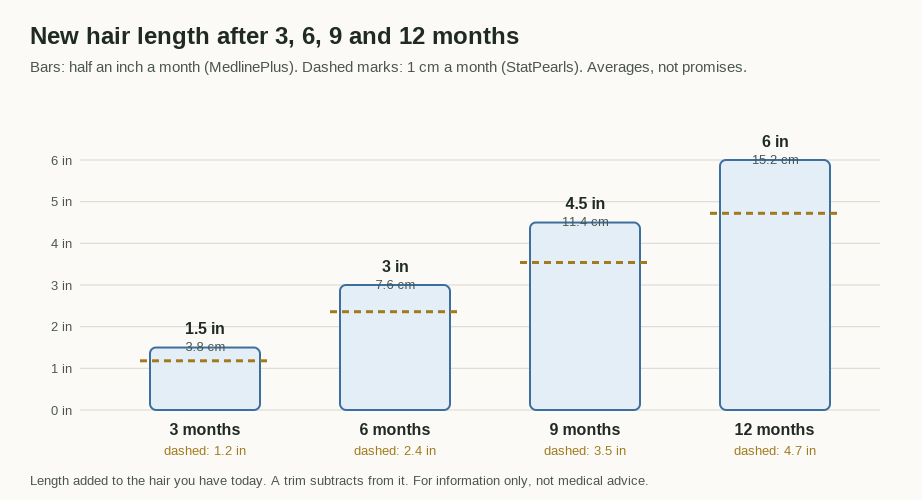
In 3 months hair grows about 1.5 inches (3.8 cm), in 6 months about 3 inches (7.6 cm) and in 12 months about 6 inches (15.2 cm) at half an inch a month. At 1 cm a month the figures are 1.2, 2.4 and 4.7 inches. Table 3 lists 1 to 24 months.
| Months | ½ in a month: inches | ½ in a month: cm | 1 cm a month: cm | 1 cm a month: inches |
|---|---|---|---|---|
| 1 | 0.5 | 1.3 | 1 | 0.4 |
| 2 | 1 | 2.5 | 2 | 0.8 |
| 3 | 1.5 | 3.8 | 3 | 1.2 |
| 4 | 2 | 5.1 | 4 | 1.6 |
| 6 | 3 | 7.6 | 6 | 2.4 |
| 9 | 4.5 | 11.4 | 9 | 3.5 |
| 12 | 6 | 15.2 | 12 | 4.7 |
| 18 | 9 | 22.9 | 18 | 7.1 |
| 24 | 12 | 30.5 | 24 | 9.4 |
Add the result to the length you have today. For an event on a known date, count the weeks. The date calculator gives the days between today and the event, and dividing by 7 gives weeks for Table 4.
| Weeks | ½ in a month: inches | ½ in a month: cm | 1 cm a month: inches | 1 cm a month: cm |
|---|---|---|---|---|
| 4 | 0.5 | 1.2 | 0.4 | 0.9 |
| 8 | 0.9 | 2.3 | 0.7 | 1.8 |
| 12 | 1.4 | 3.5 | 1.1 | 2.8 |
| 16 | 1.8 | 4.7 | 1.4 | 3.7 |
| 26 | 3 | 7.6 | 2.4 | 6 |
| 52 | 6 | 15.2 | 4.7 | 12 |
Method: weeks × 7 ÷ 30.4375 gives months, then the same two rates as before. The 52 week row is 364 days, so it lands a little under a full year.
Does cutting hair make it grow faster?
No. A 2022 news release from the American Academy of Dermatology Association quotes dermatologist Rochelle R. Torgerson, MD, PhD, saying: "hair growth occurs below the level of the skin and is not affected by cutting." A trim only removes length, so it lowers the gain you see. Table 5 shows the arithmetic.
| Trim schedule | Cut each time | Removed in 12 months | Net length gained |
|---|---|---|---|
| No trim | none | 0 in | 6 in |
| Every 6 months | ½ in | 1 in | 5 in |
| Every 3 months | ½ in | 2 in | 4 in |
| Every 3 months | 1 in | 4 in | 2 in |
| Every 2 months | 1 in | 6 in | 0 in |
Method: 12 months × 0.5 in = 6 in grown, minus the number of trims times the length cut each time. The table assumes the half-inch rate and no breakage. Trimming is a style and upkeep choice, and the table only shows what happens to the length on a ruler.
What changes how fast hair grows?
Age, nutrition and the body's own signals all play a part. StatPearls says growth is regulated by vascular, endocrine and neural stimuli in addition to age and nutritional habits, and that growth rate and hair density decrease with age. No source read for this guide shows a way to make scalp hair grow faster than its natural pace.
- Age. StatPearls, in its chapter on the hair follicle, says hair growth rate and hair density decrease with age.
- Where on the body. The growth phase of scalp hair can last 2 to 6 years, while eyebrows and eyelashes may need only a few months to grow.
- The cycle. Hair grows, pauses briefly in a transition phase of a few weeks, then rests. StatPearls says the resting phase lasts from a few weeks for eyelashes to nearly one year for scalp hair.
- Products. This guide does not recommend any product or supplement. Neither the NIH chapters nor the AAD release read for it describes a product that changes the pace.
To find your own pace, measure a section of hair from the scalp to the end in the same spot, wait three months and measure again. Compare the difference with Table 3, and add back any length that was cut in between.
How long can hair grow, and when should you talk to a dermatologist?
Each scalp hair grows for years, then rests and falls out. MedlinePlus says most hairs grow for up to six years, and StatPearls gives 2 to 6 years. For information only, not medical advice: if you are worried about thinning, shedding or hair that will not grow, talk to a dermatologist.
At half an inch a month, 2 to 6 years of growth is 12 to 36 inches (30 to 91 cm) for one hair before it falls out. That is arithmetic from two published figures, not a measured limit, and StatPearls says the growth rate decreases with age.
The American Academy of Dermatology says that after childbirth, an illness, an operation or a stressful time, shedding can increase, and that when it stops, most people see their hair regain its normal fullness within 6 to 9 months. For hair loss, the AAD also says that to get an accurate diagnosis, it helps to see a board-certified dermatologist.
Hair length is a personal choice, and no pace of growth is better than another.
Frequently asked questions
How many inches does hair grow in 6 months?
About 3 inches (7.6 cm) at half an inch a month, or about 2.4 inches (6 cm) at 1 cm a month.
How long does it take hair to grow 6 inches?
About 12 months at half an inch a month, and about 15.2 months at 1 cm a month.
How much does hair grow in a week?
About 2.9 mm (0.11 inch) at half an inch a month, or 2.3 mm (0.09 inch) at 1 cm a month, using 30.44 days in a month.
Is half an inch a month true for everyone?
No, it is an average. StatPearls says hair growth rate decreases with age and is regulated by several signals in the body, and published averages run from about 1.0 to 1.3 cm a month.
Should I see a doctor if my hair is not growing?
For information only, not medical advice: if you are worried about thinning, heavy shedding or hair that will not grow, talk to a dermatologist. The AAD says seeing a board-certified dermatologist helps to get an accurate diagnosis.
Sources
- National Library of Medicine, MedlinePlus: Hair Problemsmedlineplus.gov
- StatPearls, NCBI Bookshelf: Physiology, Hairncbi.nlm.nih.gov
- StatPearls, NCBI Bookshelf: Anatomy, Hair Folliclencbi.nlm.nih.gov
- American Academy of Dermatology: National healthy skin month, dermatologists provide tips on caring for your skin, hair, and nailsaad.org
- American Academy of Dermatology: Hair loss, diagnosis and treatmentaad.org
- American Academy of Dermatology: Hair loss, who gets and causesaad.org