How many grams of protein does an adult need a day?
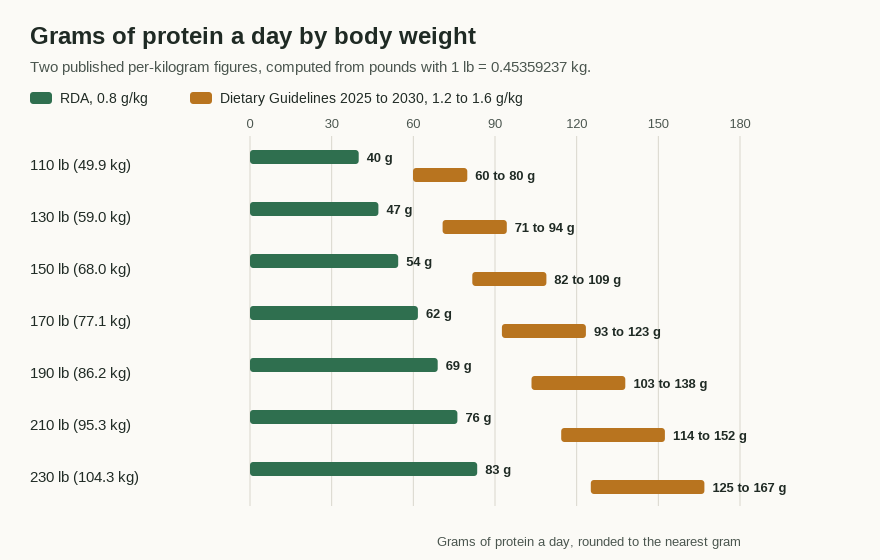
The answer depends on body weight, and two published per-kilogram figures exist: 0.8 grams a day (the RDA) and 1.2 to 1.6 grams a day (the 2025 to 2030 Dietary Guidelines for Americans). Table 1 turns both into grams for body weights in pounds. For information only, not medical advice; talk to a doctor or registered dietitian.
Grams a day = body weight in kg × grams per kg
Body weight in kg = pounds × 0.45359237
| Body weight (lb) | Body weight (kg) | RDA at 0.8 g/kg | Dietary Guidelines at 1.2 to 1.6 g/kg |
|---|---|---|---|
| 110 | 49.9 | 40 g | 60 to 80 g |
| 130 | 59.0 | 47 g | 71 to 94 g |
| 150 | 68.0 | 54 g | 82 to 109 g |
| 170 | 77.1 | 62 g | 93 to 123 g |
| 190 | 86.2 | 69 g | 103 to 138 g |
| 210 | 95.3 | 76 g | 114 to 152 g |
| 230 | 104.3 | 83 g | 125 to 167 g |
Method: each weight in pounds is converted to kilograms with the exact factor, multiplied by 0.8, 1.2 and 1.6, and each result is rounded to the nearest whole gram. The kilogram column is shown to one decimal, so a hand calculation from the rounded column can differ by a gram.
| Body weight (kg) | Body weight (lb) | RDA at 0.8 g/kg | Dietary Guidelines at 1.2 to 1.6 g/kg |
|---|---|---|---|
| 50 | 110.2 | 40 g | 60 to 80 g |
| 60 | 132.3 | 48 g | 72 to 96 g |
| 70 | 154.3 | 56 g | 84 to 112 g |
| 80 | 176.4 | 64 g | 96 to 128 g |
| 90 | 198.4 | 72 g | 108 to 144 g |
| 100 | 220.5 | 80 g | 120 to 160 g |
| 110 | 242.5 | 88 g | 132 to 176 g |
Method: the same arithmetic starting from kilograms, with pounds = kilograms ÷ 0.45359237. Use the kg to lbs converter if your weight is in the other unit, or see how many grams are in a pound for the factor itself.
Worked example. A woman who weighs 150 lb is 68 kg. At 0.8 g/kg that is 68 × 0.8 = 54.4 g, which rounds to 54 g. At 1.2 and 1.6 g/kg it is 81.6 and 108.9 g, which round to 82 and 109 g.
The same woman is the default example in the TDEE calculator, where, low active, she needs about 2,246 calories a day to keep her weight steady.
Why do the RDA and the Dietary Guidelines give different numbers?
Because they are two different documents. The National Academies publish the Dietary Reference Intakes. Their protein table is based on 0.8 g/kg/day for adults, and the NIH Office of Dietary Supplements defines an RDA as the average daily level of intake sufficient to meet the nutrient requirements of nearly all (97 to 98 percent) healthy individuals.
The Dietary Guidelines for Americans, 2025 to 2030, dated January 2026, state a protein serving goal of 1.2 to 1.6 grams per kilogram of body weight per day, adjusting as needed based on individual caloric requirements. The text read for this guide does not mention the 0.8 RDA, and it does not split the 1.2 to 1.6 figure by age group.
| Source | Figure | Edition | What the page says about who it covers |
|---|---|---|---|
| National Academies, Dietary Reference Intakes | 0.8 g/kg/day for adults | 2002/2005 report, table page | RDAs are set to meet the needs of almost all (97 to 98 percent) individuals in a group |
| Dietary Guidelines for Americans, 2025 to 2030 | 1.2 to 1.6 g/kg/day | January 2026 | One general goal on page 3, not split by age group or life stage |
| Oklahoma State University Extension | RDA stays at 0.8; 1.2 to 1.6 for some groups | Fact sheet on the 2025 to 2030 edition | Names older adults and physically active people as groups that may benefit from the higher range |
Oklahoma State University Extension reads the two together this way: the RDA for healthy adults stays at 0.8 g/kg/day, and some groups, including older adults and physically active people, may benefit from the higher range. That is one extension service's reading, not a sentence printed in the guidelines text.
This page does not pick one figure for you. Both are published, so Table 1 shows both. Which one fits you is a question for a doctor or registered dietitian.
What does 0.8 grams per kilogram mean, and who is it for?
It is a daily average, set for healthy people and not tuned to one person. The National Academies table lists the protein RDA as 56 grams a day for adult men and 46 grams for adult women, in the age rows from 19 to 30 and in the older bands, based on the 0.8 g/kg figure and a reference body weight. The reference weights are not printed on the table page read for this guide.
The sources read here describe the RDA as an intake level set to meet needs. They do not say which weight to use when yours is far from the reference weight, so that question goes to a professional.
The figure is written for adults. For children and teens, the National Academies table lists a different value for each age band, and the Dietary Guidelines say needs rise during adolescence. This guide gives no numbers for them: read the age rows in the National Academies table listed in the sources, or ask a pediatrician. During pregnancy and breastfeeding, ask your healthcare provider; the TDEE calculator itself says its estimate is not meant for them.
How many grams of protein is 10% to 35% of my calories?
Adults have a second published range, written as a share of calories. MedlinePlus says the daily recommended intake of protein for healthy adults is 10% to 35% of total calorie needs. The National Academies table lists 10 to 35 for adults, without a unit on the page. It defines this kind of range (AMDR) as the range of intake for a particular energy source that is associated with reduced risk of chronic disease while providing intakes of essential nutrients.
Grams = calories a day × share ÷ 4
The divisor is 4 because, as the National Institute of Diabetes and Digestive and Kidney Diseases says, protein has 4 calories per gram. MedlinePlus gives one example of its own: a person who eats 2,000 calories a day could eat 100 grams of protein, which is 20% of 2,000 calories.
| Calories a day | 10% of calories | 35% of calories |
|---|---|---|
| 1,600 | 40 g | 140 g |
| 2,000 | 50 g | 175 g |
| 2,400 | 60 g | 210 g |
| 2,800 | 70 g | 245 g |
| 3,200 | 80 g | 280 g |
Method: calories × 0.10 ÷ 4 and calories × 0.35 ÷ 4, rounded to the nearest gram. Your own calorie figure for keeping your weight steady comes from the TDEE calculator.
The two kinds of figure do not line up exactly, as Table 5 shows. The first example woman needs 54.4 g at 0.8 g/kg, which is 9.7% of her 2,246 maintenance calories, just under the 10% edge of the calorie range. Both are published, so neither one cancels the other.
| Example adult, low active | Maintenance calories | RDA at 0.8 g/kg | RDA as a share of those calories | 10% to 35% of those calories |
|---|---|---|---|---|
| Woman, 35, 5 ft 5 in, 150 lb | 2,246 | 54 g | 9.7% | 56 to 197 g |
| Woman, 60, 5 ft 5 in, 150 lb | 2,071 | 54 g | 10.5% | 52 to 181 g |
| Man, 35, 5 ft 10 in, 180 lb | 2,898 | 65 g | 9.0% | 72 to 254 g |
| Man, 35, 6 ft 1 in, 220 lb | 3,232 | 80 g | 9.9% | 81 to 283 g |
Method: weight in kg × 0.8 × 4 ÷ calories × 100, with calories from the TDEE calculator at the low active level. Only the age, sex, height and weight change from row to row.
How do I work out my own number in pounds or kilograms?
Four steps, with a calculator or a spreadsheet.
- Write your weight in kilograms. If you have pounds, multiply by 0.45359237, or look it up in Table 1.
- Multiply by 0.8 for the RDA figure.
- Multiply by 1.2 and by 1.6 for the range in the 2025 to 2030 Dietary Guidelines.
- Round to the nearest gram. Protein figures are averages, so a decimal adds nothing.
To compare with the calorie range, multiply each result by 4 and divide by your calories a day. The BMI calculator is a different measure that uses height and weight; the protein figures on this page use weight alone.
The figures are for a whole day, not for one meal. The sources read for this guide give a daily amount and say nothing about how to split it across meals, so this guide does not either.
What mistakes make the number come out wrong?
- Pounds typed as kilograms. Entering 150 as kg gives 150 × 0.8 = 120 g instead of 54 g, a result 2.2 times too high. Check the unit before you multiply.
- Grams of food mixed up with grams of protein. The weight of a serving is not the weight of the protein in it. Look for the protein line, not the serving weight.
- Mixing the two kinds of figure. A per-kilogram figure and a share of calories are different scales, as Table 5 shows. Compare like with like.
- Treating a range as a promise. The RDA is an average for healthy people, and the guideline figure is a range. Neither is a measurement of you.
Also check the edition of any page you read: the Dietary Guidelines read for this guide are dated January 2026, and a page written before then may quote only the older figure.
When should I talk to a doctor or dietitian?
For information only, not medical advice. Talk to a doctor or registered dietitian before you use any protein number, especially if you have a health condition, take medicine, are pregnant or breastfeeding, or are looking up an amount for a child or teen.
The figures on this page are published averages for adults. They do not set a goal for you, and they are not advice about your weight or your food. A professional can tell you which figure fits your situation, and which weight to use. The sources below hold the full tables, with the values for every age band.
Frequently asked questions
How many grams of protein is the RDA for a 150 lb adult?
About 54 grams a day at 0.8 grams per kilogram of body weight (150 lb is 68 kg). For information only, not medical advice; talk to a doctor or registered dietitian.
What do the 2025 to 2030 Dietary Guidelines say about protein?
They state a protein serving goal of 1.2 to 1.6 grams per kilogram of body weight per day, which is 82 to 109 grams at 150 lb. The text read does not split the figure by age group.
What share of calories can protein supply for an adult?
MedlinePlus says the daily recommended intake of protein for healthy adults is 10% to 35% of total calorie needs, which is 50 to 175 grams on 2,000 calories at 4 calories per gram.
Is the protein RDA different for men and women?
The National Academies table lists 56 grams a day for adult men and 46 grams for adult women, both built on 0.8 g/kg/day for adults and a reference body weight.
Sources
- National Academies of Sciences, Engineering, and Medicine: Dietary Reference Intakes, Macronutrients (table, from the 2002/2005 report)nationalacademies.org
- National Institutes of Health, Office of Dietary Supplements: Nutrient Recommendations and Databasesods.od.nih.gov
- USDA and HHS: Dietary Guidelines for Americans, 2025 to 2030realfood.gov
- National Library of Medicine, MedlinePlus: Protein in dietmedlineplus.gov
- NIDDK: Dictionary definition, calorieniddk.nih.gov
- Oklahoma State University Extension: The New Dietary Guidelines for Americans 2025 to 2030extension.okstate.edu