What does a ring size measure?
A ring size measures the inside of the ring, not the outside and not the band. Every system describes the same two lengths: the inside circumference, the distance around the opening, and the inside diameter, the width across it. Circumference equals π times diameter, so knowing one gives the other.
Circumference = π × diameter
Diameter = circumference ÷ π (π = 3.14159)
The systems differ in which length they name and where the scale starts. Larson Jewelers explains that a European size is simply the inside circumference in millimeters, so size 54 means a 54 mm opening, and that a German size is the inside diameter in millimeters. The US scale is tied to inches. UK sizes are letters, with size C at a 40 mm inside circumference. Japanese size 1 starts at a 13 mm diameter, and each size adds one third of a millimeter.
The international standard is ISO 8653:2016, Jewellery, Ring-sizes, Definition, measurement and designation. The ISO catalog entry says it specifies a method to measure ring size with a ring stick and specifies how a size is designated. The numbers here come from jewelers' charts, and every diameter can be rechecked with π.
One US step is easy to find in the chart. Brilliant Earth lists US size 3 at 44.2 mm and size 13 at 69.7 mm of inside circumference. That is 25.5 mm over 10 sizes, or 2.55 mm of circumference per full size, which is 0.81 mm of diameter (2.55 ÷ π). A half size moves the opening by about 1.3 mm around.
How do you measure your ring size at home with a string?
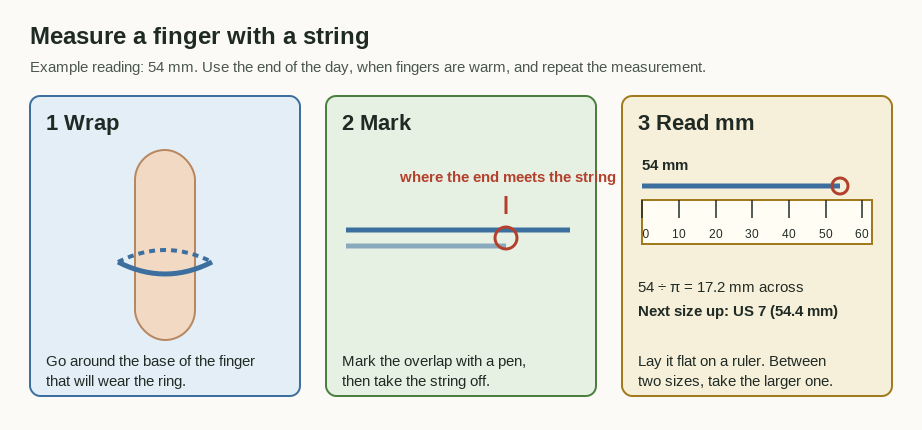
Wrap a strip of paper or a thin string around the base of the finger, mark where it overlaps, lay it flat and measure the length in millimeters. That length is the circumference of the finger. Take the next size up in the chart. If it falls between two sizes, choose the larger one, as Brilliant Earth advises.
- Wrap a narrow strip of paper or a string around the base of the finger that will wear the ring.
- Mark the point where the end meets the rest of the strip.
- Lay the strip flat against a ruler and read the length in millimeters. A tape measure gives the same number directly.
- Look the length up in Table 1 or Table 2, and move up if it falls between two sizes.
Blue Nile says finger size can vary with temperature, time of day and even which hand you use most, and that the end of the day, when fingers are warm and slightly larger, gives a better reading. The Navy Exchange adds that you should measure three or four times to catch a bad reading. It also warns that string or paper can stretch or twist. Blue Nile uses a string, and Brilliant Earth measures a strip of paper with a ruler. Choose a strip that does not stretch and repeat the measurement.
Worked example. The strip overlaps at 56 mm. The finger diameter is 56 ÷ π = 17.8 mm. In the chart, US size 7.5 is 55.7 mm, just under the strip, so the next size up is US 8 at 57.0 mm. Type the diameter as 1.783 cm into the perimeter calculator with the circle shape and it returns 5.60 cm, the 56 mm you started from.
| String length (mm) | Finger diameter (mm) | Next size up (US) | Chart circumference (mm) |
|---|---|---|---|
| 48 | 15.3 | 4.5 | 48.0 |
| 50 | 15.9 | 5.5 | 50.6 |
| 52 | 16.6 | 6.5 | 53.1 |
| 54 | 17.2 | 7 | 54.4 |
| 56 | 17.8 | 8 | 57.0 |
| 58 | 18.5 | 8.5 | 58.3 |
| 60 | 19.1 | 9.5 | 60.8 |
| 62 | 19.7 | 10 | 62.1 |
| 64 | 20.4 | 11 | 64.6 |
| 66 | 21.0 | 12 | 67.2 |
| 68 | 21.6 | 12.5 | 68.5 |
Method: diameter = length ÷ π, and the size is the smallest one in Brilliant Earth's chart whose circumference is at least the measured length. For lengths in inches, divide millimeters by 25.4; the guide on centimeters in an inch shows why that factor is exact.
How do you find your size from a ring you already own?
Measure the inside width of a ring that already fits the right finger, from one inner edge straight across to the other, in millimeters. That is the inside diameter. Multiply it by π to get the circumference, then look up either number in the chart. Measuring the outside would add the thickness of the band twice.
Worked example. A ring measures 17.3 mm across the inside. The circumference is 17.3 × π = 54.35 mm. The nearest value in Table 2 is 54.4 mm, which is US size 7. The 0.05 mm gap comes from rounding the diameter to one decimal. The perimeter calculator does the same multiplication for any diameter, in feet, inches, yards, meters or centimeters.
Blue Nile and Brilliant Earth also describe a printed sheet of circles: place the ring on it until the inside edge lines up with one circle. Brilliant Earth notes that this works for a ring that already fits well. Print the sheet at actual size, because a shrunk or enlarged printout moves every circle. If your ruler is in inches, the feet and inches calculator handles fractions of an inch.
What is the US ring size chart in millimeters and inches?
A US size 7 has an inside circumference of 54.4 mm (2.14 in) and an inside diameter of 17.3 mm. Sizes 3 to 13 run from 44.2 mm to 69.7 mm around. Table 2 lists every half size, with the diameter computed as circumference ÷ π.
| US size | Circumference (mm) | Diameter (mm), computed | Circumference (in), computed |
|---|---|---|---|
| 3 | 44.2 | 14.1 | 1.74 |
| 3.5 | 45.5 | 14.5 | 1.79 |
| 4 | 46.8 | 14.9 | 1.84 |
| 4.5 | 48.0 | 15.3 | 1.89 |
| 5 | 49.3 | 15.7 | 1.94 |
| 5.5 | 50.6 | 16.1 | 1.99 |
| 6 | 51.9 | 16.5 | 2.04 |
| 6.5 | 53.1 | 16.9 | 2.09 |
| 7 | 54.4 | 17.3 | 2.14 |
| 7.5 | 55.7 | 17.7 | 2.19 |
| 8 | 57.0 | 18.1 | 2.24 |
| 8.5 | 58.3 | 18.6 | 2.30 |
| 9 | 59.5 | 18.9 | 2.34 |
| 9.5 | 60.8 | 19.4 | 2.39 |
| 10 | 62.1 | 19.8 | 2.44 |
| 10.5 | 63.4 | 20.2 | 2.50 |
| 11 | 64.6 | 20.6 | 2.54 |
| 11.5 | 65.9 | 21.0 | 2.59 |
| 12 | 67.2 | 21.4 | 2.65 |
| 12.5 | 68.5 | 21.8 | 2.70 |
| 13 | 69.7 | 22.2 | 2.74 |
Method: the circumference column is the one Brilliant Earth prints. The diameter is that value ÷ π, rounded to 0.1 mm, and the inch value is the millimeters ÷ 25.4, rounded to 0.01 in. A diameter printed with one decimal can differ from the true one by up to 0.05 mm, which is why recomputing a circumference from it can land about 0.16 mm off.
How do US, UK, EU and Japanese ring sizes compare?
On Brilliant Earth's chart, US size 7 equals UK N ½, EU 54.5 and Japan 14. US sizes are numbers in quarter steps, UK sizes are letters with half sizes, EU sizes follow the circumference in millimeters, and Japanese sizes count up from a 13 mm diameter. Table 3 lines them up for US 4 to 12.
| US size | UK, Australia | EU (France column) | Japan, China, India |
|---|---|---|---|
| 4 | H | 47 | 7 |
| 4.5 | I | 48 | 8 |
| 5 | J ½ | 49 | 9 |
| 5.5 | K ½ | 50.5 | 10 |
| 6 | L ½ | 52 | 12 |
| 6.5 | M ½ | 53 | 13 |
| 7 | N ½ | 54.5 | 14 |
| 7.5 | O ½ | 56 | 15 |
| 8 | P ½ | 57 | 16 |
| 8.5 | Q ½ | 58.5 | 17 |
| 9 | R ½ | 60 | 18 |
| 9.5 | S ½ | 61 | 19 |
| 10 | T ½ | 62 | 20 |
| 10.5 | U ½ | 63.5 | 22 |
| 11 | V ½ | 65 | 23 |
| 11.5 | W ½ | 66 | 24 |
| 12 | X ½ | 67.5 | 25 |
The columns come from one chart, so they agree with each other. The UK letters jump from I at US 4.5 to J ½ at US 5, which means the chart skips a half letter at the small end. Charts differ most there, so check small sizes with the jeweler. Larson Jewelers also notes that sizes can differ between jewelers and recommends measuring with a sizer from the jeweler you will buy from.
How much do published ring size charts disagree?
Not by much. The diameters printed by the Navy Exchange and by Pricescope sit within 0.1 mm of the value that π gives from Brilliant Earth's circumference. A chart is a good guide, but a jeweler's sizer is the last word.
| US size | Circumference ÷ π (mm) | Navy Exchange (mm) | Pricescope (mm) | EU size (Brilliant Earth) |
|---|---|---|---|---|
| 4 | 14.90 | 14.9 | 14.8 | 47 |
| 5 | 15.69 | 15.7 | 15.7 | 49 |
| 6 | 16.52 | 16.5 | 16.5 | 52 |
| 7 | 17.32 | 17.3 | 17.3 | 54.5 |
| 8 | 18.14 | 18.1 | 18.1 | 57 |
| 9 | 18.94 | 19.0 | 18.9 | 60 |
| 10 | 19.77 | 19.8 | 19.8 | 62 |
| 11 | 20.56 | 20.6 | 20.6 | 65 |
| 12 | 21.39 | 21.4 | 21.4 | 67.5 |
Method: the second column is the circumference of Table 2 divided by π, shown to two decimals. The other two are copied as printed. The largest gap after rounding the computed value to one decimal is 0.1 mm, at US 4 and 9.
What changes the size that fits?
Several things change the fit even when the measurement is exact: time of day, temperature, the width of the band and a large knuckle. Measure at the end of the day, add at least half a size for a wide band, and ask a jeweler to check the fit, since sizes can differ between jewelers.
- Time and temperature. The Navy Exchange says fingers are smaller in the morning and when cold, and Blue Nile says they are warm and slightly larger at the end of the day.
- Knuckle. Brilliant Earth says that if the knuckle is noticeably larger than the base of the finger, you should measure both and choose a size in between.
- Band width. Brilliant Earth suggests going up at least a half size for bands over 4 mm, and sizing down accordingly for very thin designs under 1.3 mm.
- Resizing. Brilliant Earth notes that rings can generally be resized down more easily than up, which is one reason to pick the larger size when in doubt.
- Which jeweler. Larson Jewelers says the most accurate way is to be measured at a local jeweler, and that a sizer from your preferred jeweler matches that jeweler's sizes.
These are planning figures from published charts. The jeweler's own sizer and the ring's maker have the last word.
Frequently asked questions
What is a size 7 ring in mm?
On Brilliant Earth's chart, a US size 7 has an inside circumference of 54.4 mm and an inside diameter of about 17.3 mm. The same chart lists it as UK N ½ and EU 54.5.
How do I convert a ring diameter to a ring size?
Multiply the inside diameter in millimeters by π to get the circumference, then find that value in the chart. A diameter of 17.3 mm gives 54.35 mm, which sits on US size 7 (54.4 mm) in the chart.
Is ring size the diameter or the circumference?
It depends on the country. European sizes are the inside circumference in millimeters, German sizes are the inside diameter in millimeters, and the two are linked by circumference = π × diameter.
What if my finger measurement falls between two sizes?
Brilliant Earth says to choose the larger size, and notes that rings can generally be resized down more easily than up. A knuckle larger than the finger base is a reason to measure both.
How many millimeters is one full ring size?
About 2.55 mm of circumference, or 0.81 mm of diameter, for one full US size. That comes from the 25.5 mm between sizes 3 and 13 on Brilliant Earth's chart, divided by 10.
Sources
- ISO: ISO 8653:2016 Jewellery, Ring-sizes, Definition, measurement and designationiso.org
- Brilliant Earth: Ring Size Chartbrilliantearth.com
- Brilliant Earth: How to Measure Ring Sizebrilliantearth.com
- Blue Nile: How to Find Your Ring Sizebluenile.com
- Larson Jewelers: International Ring Size Conversionlarsonjewelers.com
- Navy Exchange: Ring Size Guide (PDF)mynavyexchange.com
- Pricescope: Ring Size Chartpricescope.com