How many inches of snow make 1 inch of rain?
Multiply the depth of liquid water by the snow-to-liquid ratio. Meteorologists use that ratio for the inches of snow that melt down to 1 inch of liquid. At the often-quoted 10 to 1, 1 inch of liquid is 10 inches of snow, and 1 inch of rain is the same 1 inch of liquid.
Snow depth (in) = liquid depth (in) × ratio
Liquid depth (in) = snow depth (in) ÷ ratio
The National Weather Service (NWS) packet for Nebraska calls 10 to 1 a rule of thumb and says it is not always the case, especially in the Plains states, where snow is more typically 14 to 1. It adds that very wet snow can fall below 10 to 1 and dry snow can reach 20 to 1.
The reverse is a division. Six inches of snow holds 0.6 inch of liquid at 10 to 1, 0.46 inch at 13 to 1 and 0.3 inch at 20 to 1.
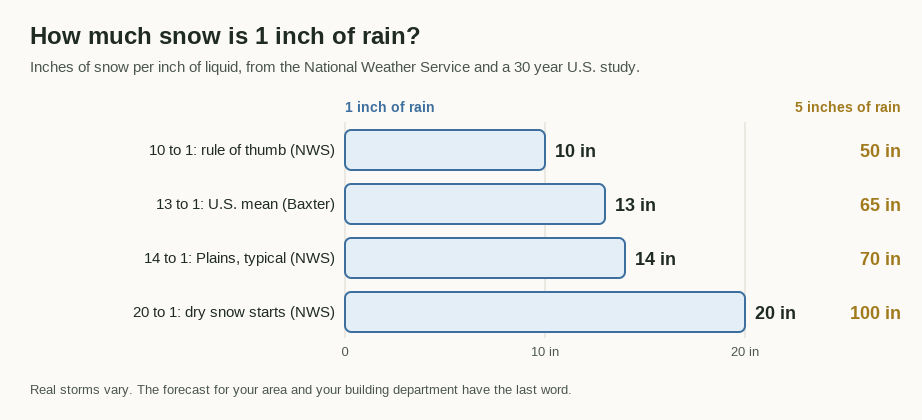
How much snow is 1 inch of rain?
About 10 to 13 inches if the same liquid fell as snow: 10 inches by the NWS rule of thumb, and 13 inches by the national mean of Baxter, Graves and Moore (2005). Wet snow gives less than 11 inches and dry snow more than 20. Rain is already liquid, so 1 inch of rain and 1 inch of liquid are the same amount.
| Ratio | 0.5 in of rain | 1 in of rain | 2 in of rain | 5 in of rain |
|---|---|---|---|---|
| 10 to 1 (rule of thumb, NWS) | 5 | 10 | 20 | 50 |
| 11 to 1 (top of wet snow, NWS) | 5.5 | 11 | 22 | 55 |
| 13 to 1 (U.S. mean, Baxter) | 6.5 | 13 | 26 | 65 |
| 14 to 1 (Plains, NWS) | 7 | 14 | 28 | 70 |
| 20 to 1 (start of dry snow, NWS) | 10 | 20 | 40 | 100 |
The question often comes as "5 inches of rain is how much snow?" Multiply by the ratio: 5 × 10 = 50 inches, 5 × 13 = 65 inches and 5 × 20 = 100 inches. Whether a storm falls as rain or snow depends on the temperature, so read the result as a way to compare amounts, not as a forecast. The same 5 inches of liquid weighs about 26 pounds per square foot of roof, whatever the ratio.
To go from snow back to rain, divide the snow depth by the ratio.
| Snow depth | At 10 to 1 | At 13 to 1 | At 20 to 1 |
|---|---|---|---|
| 10 in | 1 in | 0.77 in | 0.5 in |
| 20 in | 2 in | 1.54 in | 1 in |
| 50 in | 5 in | 3.85 in | 2.5 in |
Is the 10 to 1 rule accurate?
It is a fair starting point, not an average. Baxter, Graves and Moore (Weather and Forecasting, 2005) built a 30-year climatology of the ratio for the contiguous United States. Their abstract says a mean of 13 appears more appropriate for much of the country than the often-assumed value of 10, with considerable spatial variation.
The full dataset shows why. The mean is 13.53, the median 12.14 and the most common single value 10.0, with the 25th and 75th percentiles at 9.26 and 16.67. When the mean sits above the median and the median above the mode, the distribution has a long tail of high ratios, so the typical snowfall (the median) is above 10 to 1 and the average is higher still.
| Inches of snow per inch of liquid | What it describes | Source |
|---|---|---|
| 10 | The rule of thumb: 1 inch of liquid equals 10 inches of snow | NWS Nebraska packet, 2020 |
| 9.3 to 16.7 | The middle half of 30 years of U.S. observations (25th to 75th percentile) | Baxter et al., 2005 |
| 10.0, 12.1, 13.5 | The most common value, the median and the mean of the same data | Baxter et al., 2005 |
| 14 | More typical of the Plains states than 10 to 1 | NWS Nebraska packet, 2020 |
| 14 to 15 | December to February average at Omaha, Nebraska (11 to 1 in the heaviest storms) | WPC training slides |
| 10 to 25 | Most new U.S. snow, from the 4% to 10% water share | NSIDC |
| 10 to 12 | New snow equal to about 1 inch of water, or about 5 lb per sq ft of roof | Building America Solution Center |
| 3 to 5 | Old snow equal to about 1 inch of water | Building America Solution Center |
The National Snow and Ice Data Center (NSIDC) also calls the ten-to-one assumption not always accurate. It says most new snowfall in the United States has a water-to-snow ratio between 0.04 and 0.10, which is 10 to 25 inches of snow per inch of water. The sources do not use the same datasets or definitions, so treat each row as a range, not as competing answers.
What counts as wet, normal and dry snow?
The NWS office at Gaylord, Michigan, publishes a snow ratio map whose legend sorts snow into three classes. Wet snow is a ratio of up to 11 inches of snow to 1 inch of liquid, normal snow is 11 to 20 and dry snow is more than 20. The page is dated June 2, 2026.
| Class | Inches of snow for 1 inch of liquid | Liquid as a share of the snow depth |
|---|---|---|
| Wet snow | up to 11 | 9.1% or more |
| Normal snow | 11 to 20 | 5.0% to 9.1% |
| Dry snow | more than 20 | less than 5.0% |
The shares in the last column are computed here as 1 ÷ ratio. At 20 to 1, the liquid is 5% of the depth, so 95% of the snow layer is not water. A deep, dry snowfall can therefore hold less water than a shallow, wet one.
What makes the ratio change from one storm to the next?
NOAA's Weather Prediction Center (WPC) training slides on snowfall forecasting list the main factors. In short:
- Temperature. The fluffiest snows usually occur with light winds and temperatures near 15°F. At very cold temperatures the crystals are smaller and pack closer together, which can give 10 to 1 or lower.
- Warm layers. Warm ground and warm air near the surface can keep the ratio down, and a deep layer near freezing usually gives about 8 or 10 to 1.
- Crystal type. Lacy dendrite and plate crystals give the highest ratios. Riming, where crystals collide with supercooled droplets, lowers the ratio.
- Storm track. Northern tracks favor high ratios. Southern tracks and tracks that draw warm, moist air from the oceans rarely exceed 10 to 1 except well west of the storm track.
- Place and storm size. In Colorado the ratio is usually much higher than 10 to 1. At Omaha, ratios were highest in lighter snow events and about 11 to 1 in the heaviest storms.
Does deeper snow weigh more on a roof?
Weight follows the liquid, not the depth. The U.S. Geological Survey lists water at about 62.4 pounds per cubic foot, so 1 inch of liquid over 1 square foot weighs 62.4 ÷ 12 = 5.2 pounds. Whatever the ratio, snow that holds 1 inch of liquid weighs about that much per square foot. The Building America Solution Center, a U.S. Department of Energy program, says 10 to 12 inches of new snow, or 3 to 5 inches of old snow, equals about 1 inch of water, or about 5 pounds per square foot of roof space.
The roof snow load calculator uses typical weights for five snow types. Written as ratios against 62.4 lb per cubic foot of water, four of them look like this:
| Snow type in the calculator | lb per cu ft | Inches of snow per inch of liquid | lb per sq ft at 12 in |
|---|---|---|---|
| Light, dry snow | 3 | 20.8 | 3 |
| Fresh snow | 6 | 10.4 | 6 |
| Settled or packed snow | 15 | 4.2 | 15 |
| Wet, heavy snow | 21 | 3.0 | 21 |
The light, dry row is just inside the NWS dry class and the fresh row is close to the 10 to 1 rule. The settled row matches the Building America figure of 3 to 5 inches of old snow per inch of water. The wet, heavy row, about 3 to 1, is far denser than newly fallen snow in the tables above, so it is best read as snow that has settled or soaked up water, not a fresh snowfall. The calculator's fifth type, ice, is left out of the table because ice is not snow and has no snow-to-liquid ratio.
Worked example: a forecast of 0.60 inch of liquid
Say a forecast calls for 0.6 inch of liquid, falling as snow. The depth depends on the ratio, but the weight does not:
- At 10 to 1, the snow is 0.6 × 10 = 6 inches.
- At 13 to 1, it is 0.6 × 13 = 7.8 inches.
- At 20 to 1, it is 0.6 × 20 = 12 inches.
- In every case the liquid weighs 0.6 × 5.2 = about 3.1 pounds per square foot.
The roof snow load calculator reproduces that. Six inches of fresh snow and 12 inches of light, dry snow both come to 3 pounds per square foot. On a 40 × 30 foot roof, 1,200 square feet, that is 3,600 pounds either way. The calculator works from the snow depth and the snow type, not from the liquid: 6 inches of fresh snow is 3 pounds per square foot. The liquid route above gives 0.6 × 5.2 = 3.1, so the two agree within rounding. For comparison, 12 inches of wet, heavy snow gives 21 pounds per square foot, 7 times the dry figure for the same depth.
The same arithmetic works for water collection. The rainwater harvesting calculator gives 623 gallons for 1 inch of liquid on a 1,000 square foot roof, so the melt of 10 inches of snow at 10 to 1 over that roof is the same 623 gallons, before any losses. The water weight calculator converts such volumes to pounds.
Open the 12 inch light, dry snow example in the roof snow load calculator
Common mistakes with the snow ratio
- Treating 10 to 1 as exact. Half of the observations in the national study fell between about 9 and 17 to 1, and the other half fell outside that range. Use a range for planning and let the NWS forecast for your area decide.
- Judging the load by depth. Twelve inches of light snow can weigh far less than 12 inches of wet snow. Weight comes from the liquid.
- Using fresh-snow figures for old snow. The Building America page puts old snow at 3 to 5 inches per inch of water, against 10 to 12 for new snow.
- Forgetting the rain. Rain that soaks into a snowpack adds weight.
- Reading a snow load calculator as a safety check. The calculator is for information only, not a structural assessment. Your local building department or a licensed engineer decides what your roof can carry. Regional snow load design values are theirs to give, not this page's.
For the other half of a winter forecast, see the wind chill chart and the wind chill calculator.
Frequently asked questions
How much liquid water is in 6 inches of snow?
About 0.6 inch at 10 to 1, 0.46 inch at 13 to 1 and 0.3 inch at 20 to 1. Divide the snow depth by the snow-to-liquid ratio.
What is a snow-to-liquid ratio?
The inches of snow that melt down to 1 inch of liquid water. At 10 to 1, 10 inches of snow melt to 1 inch. The NWS calls snow wet up to 11 to 1, normal from 11 to 20 and dry above 20.
How much snow is 5 inches of rain?
About 50 inches at 10 to 1, 65 inches at 13 to 1 and 100 inches at 20 to 1. Multiply the liquid depth by the snow-to-liquid ratio, which changes from storm to storm.
Is it true that 10 inches of snow equals 1 inch of water?
Only as a rule of thumb. A 30-year U.S. study found a mean of 13.5 to 1 and a median of 12.1 to 1, with 10.0 the most common single value. The NWS says snow in the Plains is more typically 14 to 1.
Does 1 inch of rain on snow add to the roof load?
It can. The Building America Solution Center says rain on snow tends to fill the voids in the snowpack and make it quite heavy. One inch of liquid water adds about 5.2 pounds per square foot if the snow holds it.
Sources
- NSIDC: The Science of Snow (how much water is in snow)nsidc.org
- National Weather Service: Nebraska Winter Weather Awareness Day (2020), Challenges of Forecasting Snowfall Amountsweather.gov
- Baxter, Graves and Moore (2005): A Climatology of Snow-to-Liquid Ratio for the Contiguous United States, Weather and Forecasting 20, 729-744eas.slu.edu
- National Weather Service Gaylord, Michigan: Snowfall Information (snow ratio classes)weather.gov
- NOAA Weather Prediction Center: Snow forecasting training slides (snow to liquid ratios)wpc.ncep.noaa.gov
- Building America Solution Center (U.S. DOE): Managing Snow Loads on Roofs and Decksbasc.pnnl.gov
- USGS Water Science School: Water densityusgs.gov