How long a cut tree stays fresh
A real, live tree has no fixed shelf life, and no source gives a number of days that applies to every tree. University of Illinois Extension says many fresh cut trees, if properly cared for, will last at least five weeks before drying out. The National Christmas Tree Association (NCTA) says water-holding stands kept filled with plain water extend the freshness of trees for weeks. Neither promises a date, and both depend on water.
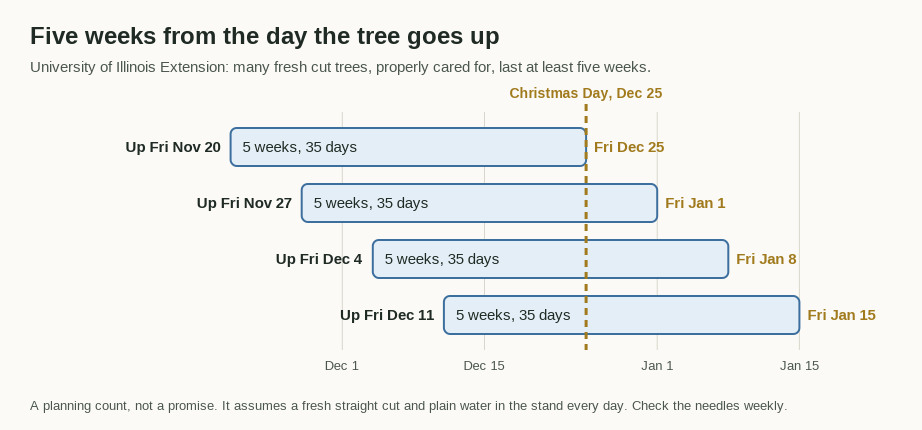
The clock starts at harvest, not at your door. Penn State Extension notes that most trees are cut in the first couple of weeks of November, so a tree put up by Thanksgiving or early December is already some days old. If you count five weeks from the day the tree goes up, the table shows where the planning count lands.
| Tree goes up | Five weeks later |
|---|---|
| Friday, Nov 20 | Friday, Dec 25 |
| Friday, Nov 27 | Friday, Jan 1 |
| Friday, Dec 4 | Friday, Jan 8 |
| Friday, Dec 11 | Friday, Jan 15 |
The species matters too. NC State Extension rates a few common choices.
| Tree | What NC State says |
|---|---|
| White pine | Excellent needle retention |
| Fraser fir | Good needle retention |
| Virginia pine | Good needle retention when displayed in water |
| Red cedar | Dries rapidly in a warm house unless regularly watered |
| Leyland cypress | Dries rapidly in a warm house unless regularly watered |
Check the tree against the signs in the section on a drying tree below, and take it down early rather than late.
How long can a Christmas tree go without water?
The sources set the limit in hours, not days. Most species still take up water 6 to 8 hours after the trunk is cut (National Christmas Tree Association), and Penn State Extension says to recut after 12 hours. Once the stand runs dry, NC State Extension says the tree may not readily take up water again.
| Source | Limit | What the page says |
|---|---|---|
| NCTA care tips | 6 to 8 hours | Most species can go that long after cutting the trunk and still take up water |
| NCTA FAQ | 3 to 6 hours | Air gets into the cut stump; make a fresh cut if possible, and one half inch is enough |
| Penn State Extension | 12 hours since harvest | Longer than that and the trunk should be recut to improve water uptake |
| NC State Extension | 3 or more days out of water | Make a fresh cut on the trunk before display |
The two NCTA pages differ, and none of the pages explains why, so treat the first hours as a range of about 3 to 12 hours. The clock starts at harvest, not at purchase, so a tree from a lot may already be past these limits. When you do not know when it was cut, make a fresh straight cut at home.
Once the tree is in the stand, the rule is the water level. NCTA says to check the stand daily so the level never goes below the base of the tree. University of Illinois Extension says that if the base dries out, resin forms over the cut end and the tree can no longer take up water. Penn State Extension says of Colorado blue spruce that once it dries out, even once, many needles will fall.
No page gives a number of days that a tree in a stand can go dry and still recover. Refill the stand at once, then run the needle checks in the section on a drying tree below. If the needles break easily or fall off in your hand, Penn State Extension says the tree is dry and should be removed.
How much water a Christmas tree drinks
NCTA says that, as a general rule, stands should provide 1 quart of water per inch of stem diameter. Measure the trunk across at the cut, then read the table. The first week is the thirstiest, and University of Illinois Extension says a fresh-cut tree can use one-half to two gallons of water the first day.
| Trunk diameter | Stand should hold at least | In gallons |
|---|---|---|
| 2 in | 2 quarts | 0.5 gallons |
| 3 in | 3 quarts | 0.75 gallons |
| 4 in | 4 quarts | 1 gallon |
| 5 in | 5 quarts | 1.25 gallons |
| 6 in | 6 quarts | 1.5 gallons |
Stand capacity, at least = trunk diameter in inches × 1 quart
NCTA gives one example: for a 4 inch trunk, the stand should hold at least 1 gallon (4 quarts) with the tree in it, and it says to avoid small "coffee cup" stands. NC State Extension puts it more loosely, saying a tree might consume more than a quart of water a day.
The rule that matters most is the level, not the amount. NCTA says to check the stand daily so the water never goes below the base of the tree. University of Illinois Extension says a seal forms when the stem is exposed to air, which is why the cut must be fresh whenever the tree has been out of water.
Water also matters for safety, covered in the fire safety section below. To size the light strings for the tree, the christmas lights calculator works out how many strands a tree or house needs.
The fresh cut, the stand and the water
A tree takes up water through the cut surface, so the cut matters. Sources agree on a straight cut across the trunk, and NCTA warns against an angled or V-shaped cut. They differ on how much to remove.
| Source | How much to cut | When |
|---|---|---|
| National Christmas Tree Association | About a ½-inch disk | Before setting the tree in the stand |
| NC State Extension | A disk about half an inch thick | If stored out of water for 3 or more days |
| University of Illinois Extension | One inch | When bringing the tree indoors |
| Electrical Safety Foundation International | 1 to 2 inches | Right before placing the tree in the stand |
How long a tree can sit before it needs a new cut is set out in the section on going without water above. When you do not know how old the cut is, make a fresh one.
Choose a stand that fits the trunk. NCTA says to avoid whittling the sides of the trunk down to fit a stand; choose a stand that fits the trunk instead.
Put only plain water in the stand. NCTA says research has shown that plain tap water is best, and that some commercial additives and home mixtures can reduce moisture retention and increase needle loss. University of Illinois Extension says not to add aspirin, sugar, soda pop or anything else. NCTA's care tips also say that drilling a hole in the base of the trunk does not improve water uptake.
Signs a tree is drying out
Run these checks every week, and again before you plug in the lights.
- Tug a needle. Penn State Extension looks for flexible needles that stay firmly attached when you tug. Needles that break easily or fall off in your hand mean the tree is dry.
- Brush a branch. NC State Extension says few or no needles should drop or break when you lightly brush a limb.
- Shake the tree. NC State says green needles from the outer branches should not fall. Some old brown inner needles dropping is normal.
- Look at the stand. If the water was ever allowed to run below the base, expect a drier tree.
Penn State Extension says that if the needles break easily or fall off in your hand, the tree is dry and should be removed. The USFA says the same in plain terms: remove the tree after Christmas or when it is dry.
Heat, lights and fire safety
Water is also a fire safety measure. The U.S. Fire Administration says to water the tree every day, and that a dry tree can burn very hot and very fast. It says to keep the tree at least 3 feet from fireplaces, radiators, space heaters, candles and heat vents, and not to block exits. The Electrical Safety Foundation International gives the same 3 feet and says to refill the stand daily.
Lights matter, too. NCTA says lights that produce low heat, such as miniature lights, reduce drying, and to turn the tree lights off when leaving the house or going to bed. Penn State Extension says newer LED lights produce less heat than older types. NC State Extension says not to turn the lights on at all if you think the tree has dried out.
The USFA says to check holiday lights every year before putting them up, to throw away strands with frayed or pinched wires, and to follow the manufacturer's instructions on how many strands can be connected. The U.S. Fire Administration repeats an NFPA figure: almost one-third of home Christmas tree fires are caused by electrical problems.
The electricity cost calculator shows what a string of lights adds to a bill, and the christmas lights calculator sizes the strands before you buy them.
Common mistakes with a cut tree
- Letting the stand run dry. NCTA says to check the stand daily so the water level never goes below the base of the tree.
- Using a stand that is too small. For a 4 inch trunk, NCTA wants at least a gallon.
- Whittling the trunk to fit. NCTA says to avoid it and to pick a stand that fits the trunk.
- Adding sugar, aspirin or soda. Illinois Extension and NCTA both say plain water is best.
- Putting the tree next to a heat source. Keep it at least 3 feet from vents, radiators and fireplaces.
- Leaving it up too long. NCTA says to remove it after Christmas or if it is very dry. It also says never to burn any part of the tree in a wood stove or fireplace.
Plan the light strings once the tree is chosen. A taller tree takes more strands, and the christmas lights calculator does that count, while the watts and amps calculator converts watts to amps for the total load. Once the tree is standing, the guide on how many ornaments a Christmas tree needs covers the decorating.
Frequently asked questions
How many weeks can a real Christmas tree stay up?
University of Illinois Extension says many fresh cut trees, properly cared for, will last at least five weeks before drying out. Take the tree down once the needles are dry and brittle.
How much water does a Christmas tree need?
The National Christmas Tree Association says the stand should provide 1 quart of water for each inch of trunk diameter, so a 4 inch trunk needs a stand that holds at least 4 quarts. University of Illinois Extension says a fresh-cut tree can use one-half to two gallons of water the first day.
Should I put sugar or aspirin in Christmas tree water?
No. The National Christmas Tree Association says plain tap water is best, and University of Illinois Extension says not to add aspirin, sugar, soda pop or anything else.
Can a Christmas tree take up water again after the stand ran dry?
Maybe not. NC State Extension says that if the tree stand is allowed to dry out, the tree may not readily take up water again. Refill the stand and check the needles. Penn State Extension says a tree whose needles break easily or fall off in your hand is dry and should be removed.
Do I need to cut the bottom of a Christmas tree again at home?
It depends on how long ago it was cut. The sources give limits from about 3 to 6 hours up to 12 hours, so if you do not know when the tree was cut, make a fresh straight cut at home.
Sources
- National Christmas Tree Association: Care tipsrealchristmastrees.org
- National Christmas Tree Association: FAQrealchristmastrees.org
- University of Illinois Extension: Caring For Live Christmas Treesextension.illinois.edu
- University of Illinois Extension: Selection and Care of Fresh Cut Christmas Treesextension.illinois.edu
- NC State Extension: Selection and Care of Christmas Treescontent.ces.ncsu.edu
- Penn State Extension: Tips for Selection and Care of Cut Christmas Treesextension.psu.edu
- U.S. Fire Administration: Holiday Fire Safetyusfa.fema.gov
- Electrical Safety Foundation International: Christmas Tree Safety Tipsesfi.org